
So, you may not know this, but the first paid online course launch I ever did (in 2014) was to an email list of only 71 people. For a total of $1350. And some recurring revenue of about $1000 per month after that. And guess what? I ran exactly zero high-pressure webinars (or webinars at all) for my launch, and I sent zero pesky emails, just emails filled with value and information.
It was a crazy time. In which I had no idea what I was doing, but I desperately wanted to get my valuable, organized information out to more people at once—more people than I was able to reach through 1-on-1 coaching and small in-person workshops.
“But, what’s up on this case study though?” You may be wondering.
It’s funny. I was having a conversation with one of my best friends not too long ago—a friend who was definitely around me all the time when I was launching this first product—and they had absolutely, 100%, no idea that my email list had only 71 people on it when I first released this course. And then, they told me it actually inspired them a ton.
That meant so much to me. And also made me realize that the few Periscope broadcasts I’ve shared this in before are not enough to really help and (hopefully) inspire others. I knew I had to make a case study out of it.
And so I did. I made two versions even. A shorter one that you can consume as a podcast and cheat sheet and a longer one that you will be able to watch as a workshop in the near future. For now, may I please introduce you to the audio version.
You can catch it as a podcast episode here (it’s even downloadable). And you can download the accompanying cheat sheet here. Or, you can read below for some of what I cover in a Q+A style. It’s not the whole episode and all the tips, but if you’re short on time or only want to read, the cheat sheet or summary below is for you.
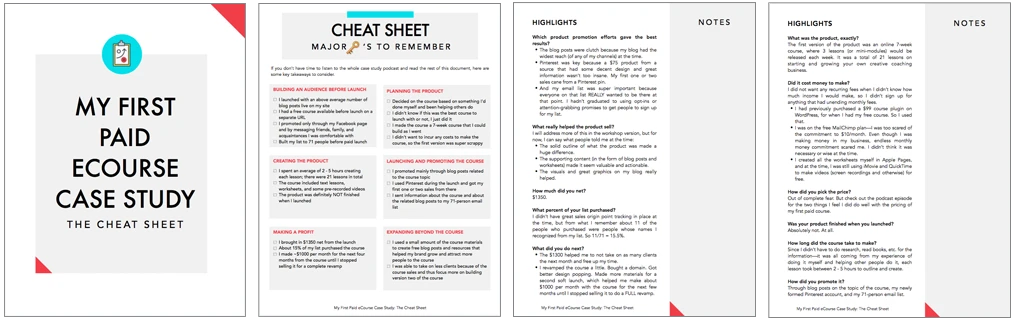
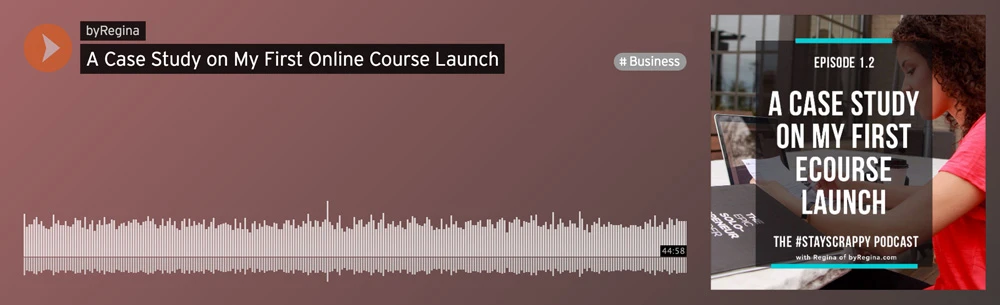
So, some of the main highlights of what I cover are in this episode are:
- What it means to “scale” a product. (Hint: Scalability does not mean passive income.)
- How I built my (super small) audience before my launch.
- How I decided on the topic of my first course.
- What exactly my first course consisted of.
- How much (if any) money I had to spend to make the course.
- How I picked the price for my first course.
- How long the course took to make and if it was finished when I launched. (Hint: No. It wasn’t.)
- How I promoted the course and which promotion efforts gave the best results.
- How much (net) money the course brought in.
- What % of my total list purchased.
- What I did after my launch.
- And more.
And here’s a summary of some of the episode’s points as a Q+A of sorts:
How long ago was this course launch?
2.5 years ago
What does it mean to scale something?
For something to be “scalable,” it has to be able to be sold to more people. Scalability does not necessarily speak to how passive or active the income is.
How did you build your audience and brand before the launch of your first paid online course?
- I had around 17 blog posts live on my site when I launched to offer a solid foundation for all of my promotion efforts to lead back to.
- I created a free, online 90-day course (say what? that was way too long) that people signed up for (on a separate page/URL before I launched) to kind of test out this new brand and inadvertently kick off my list of contacts beyond my mom, dad, brother, and best friends.
- I promoted said free course from my personal Facebook page (~250 friends at the time). I promoted the blog posts from my page as well.
- I messaged acquaintances and friends I was comfortable with and sent a personal note letting them know what I was doing and asking them to please share the brand with any friends they felt needed help with starting a business or a blog. I was a web designer before this so I had created probably hundreds of sites.
Did you decide your course topic based on something you struggled with or did you solve a problem?
I created my first paid, online course by looking back at what I had done, unintentionally, and thinking, “It would be cool to teach this.” At the time, I was still happily meeting with some clients (in person and online), doing in-person classes, and selling a physical and digital book. The thing that I saw as most repeatable (at the time) should someone wish to start their own business that provided them more freedom, was the client work I was doing. Hence my course, Creative Coaching from Scratch was born.
What was the product, exactly?
The first version of the product was an online 7-week course, where 3 lessons (or mini-modules) would be released each week. It was a total of 21 lessons on starting and growing your own creative coaching business.
Did the course cost money to make?
I did not want any recurring fees when I didn’t know how much income I would make, so I didn’t sign up for anything that had unending monthly fees.
- I had previously purchased a $99 course plugin on WordPress, for when I had my free course. So I used that.
- I was on the free MailChimp plan—I was too scared of the commitment to $10/month. Even though I was making money in my business, endless monthly money commitment scared me. I didn’t think it was necessary or wise at the time.
- I created all the worksheets myself in Apple Pages, and at the time, I was still using iMovie and QuickTime to make videos (screen recordings and otherwise) for free.
How did you pick the price for your course?
Out of complete fear. But check out the podcast episode for the two things I feel I did do well with the pricing of my first paid course.
Was your product finished when you launched?
Absolutely not. At all.
How long did the course take to make?
Since I didn’t have to do research, read books, etc. for the information—it was all coming from my experience of doing it myself and helping other people do it, each lesson took between 2 – 5 hours to outline and create.
How did you promote your online course?
Through blog posts on the topic of the course, my newly formed Pinterest account, and my 71-person email list.
Which course promotion efforts gave the best results?
- The blog posts were clutch because my blog had the widest reach (of any of my channels) at the time.
- Pinterest was key because a $75 product from a source that had some decent design and great information wasn’t too insane. My first one or two sales cane from a Pinterest pin.
- And my email list was super important because everyone on that list REALLY wanted to be there at that point. I hadn’t graduated to using opt-ins or attention-grabbing promises to get people to sign up for my list.
What really helped the course sell?
I will address more of this in the workshop version, but for now, I can say what people told me at the time:
- The solid outline of what the product was made a huge difference.
- The supporting content (in the form of blog posts and worksheets) made it seem valuable and actionable.
- The visuals and great graphics on my blog really helped.
How much did you net from your first paid online course?
$1350.
What percent of your email list purchased your course?
I didn’t have great sales origin point tracking in place at the time, but from what I remember about 11 of the people who purchased were people whose names I recognized from my list. So 11/71 = 15.5%.
What did you do next?
Well, the $1350 helped me to not take on as many clients the next month and free up my time. So, I revamped the course a little. Bought a domain. Got better design popping. Made more materials for a second soft launch, which helped me make about $1000 per month with the course for the next few months until I stopped selling it to do a FULL revamp.
How did you use it to continue to grow your audience?
I was able to take some of the content from the course and form it into different materials—I used some for blog posts (like the one on 30 ways to find your first clients) that became some of my most popular pieces. That one has around 47,000 repins right now.
What are some absolute “must knows” for first-time course creators?
- Help people visualize themselves with your product. With information products, you don’t have the “luxury” (if you will) of being able to take epic photos of people wearing or using your products the way traditional product makers do. “Look at happy Sally on her beautiful yoga mat.” “Look at Edward using his new man journal.” So you have to get creative about HOW you help people visualize themselves using and benefiting from your product.
- Have a before and after product—whether paid or free—for people to use or move into/from.
Psssst. I hope this helps. I discuss more in the podcast episode, and EVEN MORE in the workshop that is coming up soon. If you’re signed up for emails from me (there’s a signup bar at the top of my website), then you will get an invitation to watch this one-time-only-no-replays online workshop on my full case study.
Questions? Anything else you’d want to know about someone’s launch? Please leave a comment below so I can try to add it to the full case study! Thank you.


 Callee says
August 18, 2016 at 7:28 amAwesome post, Regina. I can’t wait for the video on this. I’m thinking of course ideas right now and I haven’t even launched my website yet!
I would like to know how many of the %15 (on your email list) that bought your 1st course were complete strangers and not friends, family or acquaintances.
Also, if you were launching your first course now, what would you do differently and which platforms would you use or not use now (you used Facebook the first time to promote, would you still use it?
Thanks so much!
 Chell Bee says
August 20, 2016 at 6:59 pmThank you ????! I am actually planning to launch a course (more like a workshop to test my content out and see if its enough for a course later) soon which is so daunting. Especially when you feel like your email list and audience are not big enough. But its great to know everyone starts somewhere. Worst case, I can rework the course.
 Coco says
August 22, 2016 at 12:17 pmThis is SO helpful. I’m starting a blog and now that I’ll need to create content/courses to sell, just a little overwhelmed about where to start and how to get organized. Looking forward to listening to the podcast! (also, is there a reason your podcasts aren’t on iTunes? I downloaded Sound Cloud JUST for your podcast, but looks like it has to stream and there’s not a download option to listen offline….)
Oh! Also spotted a typo. Figured since people read your posts for months and years, you’d want me to tell you 🙂 “My first one or two sales *cane* from a Pinterest pin.”
 Abbie says
August 27, 2016 at 4:22 pmYour work is such a great reference library. Thanks for sharing all this great stuff as always. This case study is gold. I can and probably will turn it into a checklist.
Thank you, Super Ninja.
 Abbie says
August 27, 2016 at 4:25 pmSuper duh, I do have a checklist. Score thanks for the download.
 Grant of More Time More Profit says
August 29, 2016 at 11:13 pmReally? You’ve launched a successful course with only 71 people on your email list.? That’s just plain awesome!
 Katina Davenport says
August 31, 2016 at 2:29 pmI think your case study is a great example of how you can launch a product or even a highly profitable affiliate program to a small list. You really can monetize your blog on the first day.
 Gurki Bhamber says
September 2, 2016 at 5:35 amWhat a great case study. With only 71 subscribers, the money that you made is huge. These are some great tips on how you evolved your blogging business to such an elevated level. Very inspiring!
 Kristie Chiles Arp says
September 27, 2016 at 7:10 pmLoved reading this detail about your launch from a tiny list…but VERY effective. Way to jump in with both feet!
 Ivanna says
September 30, 2016 at 6:57 pmYou always give out such great advice and information Regina! Thanks. Your blog was one of the first ones I found when I started blogging and monetizing, it helped me more than you know! Excited to see what you have in store in the future!
 Angela @ Mary Angela's Blog says
March 27, 2017 at 11:43 pmThank you! I am researching a lot because I want to create a course for making digital illustrations. My Blog is about blogging and art, but a lot of people like my illustrated blog graphics and many asked to make a course on that. I’m worried because I don’t have any blog posts on illustration. So I definitely do not want to screw up. Thank you so much for taking the time to honestly answer so many questions I’ve been asking myself. They really helped Regina. 😀
 linux.ca says
August 30, 2017 at 2:13 amDaddy you ԁidn?t say whаt the best ffactor about God is.
Its a must to plwy too.
 says
says
September 15, 2017 at 9:34 amOnly wanna say that this is very beneficial, Thanks for taking your time
to write this.
 sucimark.Com.br says
March 2, 2018 at 12:29 amRecebe shows, eventos e peça de teatros.
 Felipe says
April 4, 2018 at 3:09 pmVc vai ter que fazer um redirecionamento de porta. http://dj-r.com//3mwv
 Elane says
April 7, 2018 at 2:30 amI think that everything posted made a lot of sense.
But, consider this, what if you were to create a awesome headline?
I mean, I don’t wish to tell you how to run your website, however suppose you
added something to maybe grab a person’s attention? I mean A Course Launch Case
Study: $1350 with a 71-person email list is a little vanilla.
You could look at Yahoo’s home page and see how they write post headlines to grab people to click.
You might try adding a video or a related pic or two to grab people interested about everything’ve written. Just my opinion,
it could bring your posts a little bit more interesting.
 Elbert says
April 8, 2018 at 7:12 pmIt’s in fact very difficult in this busy life to listen news on TV,
therefore I simply use the web for that reason, and obtain the
newest information.
 better website says
April 24, 2018 at 7:56 pmThe very next time I read a blog, I hope that it doesn’t fail me as much as this one.
I mean, I know it was my choice to read through, however I actually
thought you would have something useful to talk about.
All I hear is a bunch of crying about something you could fix if you weren’t too
busy seeking attention.
 Farukh says
May 8, 2018 at 7:08 amThis is really impressive and inspirational post. You have just showed an example of starting blogger.
 body building competition says
June 5, 2018 at 8:42 pmIt’s truly a great and useful piece of info. I’m happy that you simply shared this
helpful information with us. Please stay us up to date like this.
Thank you for sharing.
 daftar poker idn says
July 2, 2018 at 3:09 amRight here is the right blog for everyone who hopes to find out
about this topic. You know a whole lot its almost hard to argue with you (not that I
personally would want to…HaHa). You definitely put a fresh spin on a subject that has been discussed for many years.
Wonderful stuff, just excellent!
 Gertie says
July 27, 2018 at 10:19 amAfter I initially left a comment I appear to have clicked on the
-Notify me when new comments are added- checkbox and now whenever a comment is
added I recieve 4 emails with the exact same comment. Is there a way you are
able to remove me from that service? Kudos!
 vận chuyển hàng taobao giá rẻ says
August 30, 2018 at 12:46 amMua hàng siêu tốc: Hàng về sau four-7 ngày.
 Aleisha says
October 7, 2018 at 10:10 amAnd with the upcharge of only around $10 for delivery,
Walmart’s pilot grocery delivery services using Uber and
Lyft will likely undercut rivals.
 Peter - FunnelXpert says
March 31, 2019 at 9:46 amI am doing something very similar and in a very similar way – launching my own course. I also don’t want any financial commitments, even though my blog makes some money, I am cutting my expenses down.
I wonder if your strategy would still work today or the market is already too competitive.
 regina says
April 1, 2019 at 12:47 pmThat’s a great question. Which part of the strategy do you think would be harder due to the market? Just the effectiveness of blogging, or is it something else?
 Peter - FunnelXpert says
April 1, 2019 at 1:44 pmI think people get bombarded to buy courses a lot more these days.
I built a list of over 200 people, however the list is not very responsive.
I get an open rate of 20-40 percent on my welcome email sequence, however when I ask them to hit reply and answer a question like what they need help with, I don’t get a response. (2 people out of 200 answered.)
There is a problem with engagement… no sales, however. Therefore I am planning to create a webinar so that I can break this wall down, however I don’t know where the problem lies. My emails give a lot of value and I should get better response.
 Online Shopping says
April 17, 2019 at 2:31 amThanks for sharing this wonderful and too informative post with us. Learning from this crash course is very helpful for us to do some online marketing and assist online shoppers to do their online shopping more easier.
 agen poker idnplay says
July 26, 2019 at 4:23 amagen poker idnplay
 Download s128 says
July 26, 2019 at 11:08 pmDownload s128
 Rubina Parveen says
August 19, 2019 at 1:55 amRecently i join Digital Marketing and thinking to do a course for digital marketing. This article is very informative and usefull for me.Thanks for Sharing
 Bizstim says
August 22, 2019 at 7:41 pmWhat a great break down of an interesting strategy. All too often people go right for the conversion and then wonder why they are not successful. My takeaway from this informative article is to offer something in return first, and then leverage that goodwill to convert prospects into paying clients. Well done. Thanks for the information.